
Optimizing Electronics with Advanced Capacitors
- Gulshan Sharma
- Dec 1, 2025
- 4 min read

When it comes to pushing the boundaries of electronics design, capacitors play a pivotal role. These small but mighty components influence everything from power management to signal integrity. As technology evolves, so do the demands on capacitors. That’s why advanced capacitor solutions are becoming essential for electronics companies, product developers, and semiconductor firms aiming to innovate faster and smarter.
In this post, I’ll walk you through how these advanced capacitors can optimize your electronic products. We’ll explore their benefits, dive into what capacitors actually do, and discuss practical ways to integrate them into your designs. Ready to boost your electronics with cutting-edge capacitor technology? Let’s get started.
Why Advanced Capacitor Solutions Matter
The electronics industry is moving at lightning speed. Devices are getting smaller, faster, and more complex. This means the components inside must keep up. Advanced capacitor solutions offer several key advantages:
Higher capacitance in smaller packages: This saves valuable board space.
Improved reliability and lifespan: Critical for long-term product performance.
Better frequency response: Essential for high-speed circuits.
Enhanced thermal stability: Keeps devices running smoothly under stress.
For example, in power supply circuits, advanced capacitors help reduce voltage ripple and noise, leading to cleaner power delivery. In RF circuits, they maintain signal integrity by minimizing losses. These improvements translate directly into better product quality and customer satisfaction.
If you’re looking to accelerate your product development cycle, integrating the right capacitors early on can save time and reduce costly redesigns. Plus, with the rise of AI and smart electronics, the demand for precision and efficiency in components has never been higher.
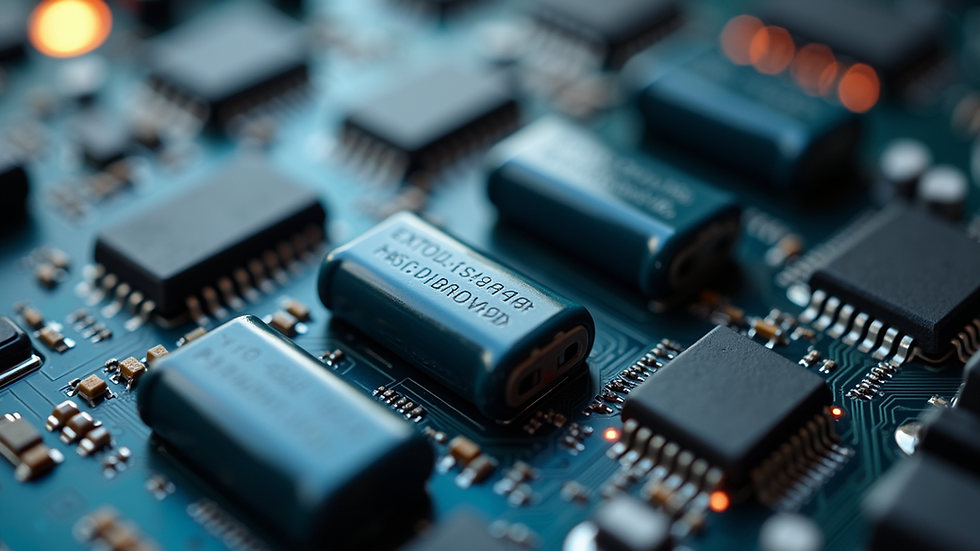
Exploring Advanced Capacitor Solutions in Electronics
Advanced capacitor solutions are not just about size and capacity. They encompass a range of technologies and materials designed to meet specific challenges in modern electronics. Here are some popular types and their unique benefits:
Ceramic Capacitors
Great for high-frequency applications
Low equivalent series resistance (ESR)
Stable over a wide temperature range
Tantalum Capacitors
High capacitance per volume
Excellent for power filtering
Reliable under steady-state conditions
Polymer Capacitors
Low ESR and high ripple current capability
Longer lifespan compared to traditional electrolytics
Ideal for compact, high-performance designs
Film Capacitors
Superior insulation and low dielectric absorption
Used in precision analog circuits and audio applications
Choosing the right capacitor depends on your specific application needs. For instance, if you’re designing a high-speed data converter, ceramic capacitors might be your best bet. On the other hand, power supply modules often benefit from polymer capacitors due to their robustness.
Incorporating these advanced capacitor solutions can significantly enhance your product’s efficiency and reliability. It’s also worth noting that working with trusted suppliers ensures you get consistent quality and support throughout your development process.
What is a Capacitor and Its Function?
Let’s take a step back and clarify what a capacitor actually does. At its core, a capacitor is a passive electronic component that stores and releases electrical energy. It consists of two conductive plates separated by an insulating material called a dielectric.
Here’s how it works:
When voltage is applied, the capacitor stores energy in the electric field between the plates.
It can then release this energy when needed, smoothing out voltage fluctuations or providing bursts of power.
Capacitors also block direct current (DC) while allowing alternating current (AC) to pass, making them useful in filtering and signal processing.
Capacitors serve many functions in electronics, including:
Energy storage: Stabilizing power supply lines.
Filtering: Removing noise from signals.
Timing: Working with resistors to create delays.
Coupling and decoupling: Isolating different parts of a circuit.
Understanding these basics helps you appreciate why selecting the right capacitor is crucial. The dielectric material, capacitance value, voltage rating, and physical size all impact how well a capacitor performs in your design.
For those interested in exploring a wide range of capacitor components, I recommend checking out specialized suppliers who offer detailed specs and support.

Practical Tips for Integrating Advanced Capacitors
Now that you know why advanced capacitors matter and how they function, let’s talk about practical steps to optimize your electronics with them.
1. Define Your Requirements Early
Start by identifying the key electrical parameters your capacitor must meet: capacitance, voltage rating, ESR, and temperature range. This upfront clarity prevents costly mistakes later.
2. Consider the Operating Environment
Will your device face extreme temperatures or mechanical stress? Choose capacitors with appropriate thermal and mechanical ratings to ensure durability.
3. Optimize Layout for Performance
Place capacitors as close as possible to the components they support. This reduces parasitic inductance and improves filtering effectiveness.
4. Use Simulation Tools
Leverage circuit simulation software to model capacitor behavior under different conditions. This helps you predict performance and avoid surprises.
5. Collaborate with Suppliers
Work closely with capacitor manufacturers or distributors. They can provide valuable insights on the latest technologies and help tailor solutions to your needs.
6. Test Thoroughly
Perform real-world testing to validate capacitor performance in your final product. Pay attention to ripple current handling, temperature stability, and aging effects.
By following these steps, you can harness the full potential of advanced capacitor solutions and deliver products that stand out in quality and reliability.
Driving Innovation with Capacitor Technology
The future of electronics depends heavily on continuous innovation in components like capacitors. As devices become smarter and more connected, the demand for efficient power management and signal integrity grows.
Advanced capacitors are at the heart of this transformation. They enable:
Faster charging and discharging cycles for energy storage systems.
Improved noise suppression in sensitive analog and digital circuits.
Miniaturization of devices without sacrificing performance.
Enhanced thermal management for high-power applications.
Moreover, as AI integration expands, capacitors help maintain stable power delivery to complex processors and sensors. This stability is critical for reliable AI operation and data processing.
By investing in the latest capacitor technologies, electronics companies can accelerate product development and reduce time to market. This aligns perfectly with the goal of building the coolest tech company on the planet, driving innovation, and making electronics product development faster and more efficient for everyone.
If you want to explore a broad selection of high-quality capacitor components, consider visiting Xelec’s capacitor components page for detailed options and expert support.
Harnessing advanced capacitor solutions is not just about keeping up with technology - it’s about leading the charge into the future of electronics.


Comments